Concept document
Categories:
Concept documents bridge users’ existing knowledge with the information they need to use a product. My “About Chronologue Relay P2P Protocols”—which appears on a website created with the Sphinx static site generator—models this type of documentation.
Read the document
Background
I wrote “About Chronologue Relay P2P Protocols” as a contributor to The Good Docs Project, an open-source project that offers templates and resources to advance documentation best practices.
This document:
Models how product development teams, documentarians, or other users can put The Good Docs Project’s Concept template to use.
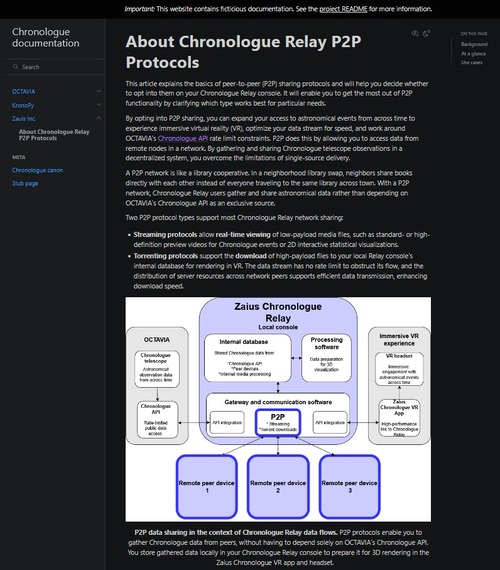
Specifies need-to-know conceptual information for fictional users of an imaginary product, the Chronologue Relay.
- The Chronologue Relay enables its (fictional) users to experience observations from the Chronologue—an (imaginary) time-travel telescope—in 3D virtual reality.
Intended audience
This example concept document envisions a (fictional) audience of Chronologue hobbyists, museum exhibit coordinators, STEM researchers, university educators.
Example user goals
- Acquire the Chronologue telescope data needed to support VR experiences of astronomical events from across time.
- Develop and present 3D visualizations that either (a) illustrate key space and time concepts for a student or public audience or (b) demonstrate scientific research for a professional audience.
- Share events with Chronologue Relay community members.
Example technical familiarity
- Users are comfortable with digital technology, but not so advanced that they can customize their interaction with the Chronologue API or contribute to KronoPy-developed libraries for manipulating Chronologue data.
Example user pain points
- OCTAVIA’s data rate limitations restrict what they can view in VR from a direct Chronologue API data stream.
- Their incomplete understanding of Chronologue data flows leads to a suboptimal use of data resources (e.g., spending time and wasting internal database memory downloading a Chronologue event that they later realize was not interesting to them).